Field training courses

Petroleum system of the Romanian Carpathians

World-class analogue outcrops of a full petroleum system — reservoir, source, seal and trap — in the Eastern Carpathian Bend Zone, one of the world's oldest oil provinces.

Petroleum system of the Romanian Carpathians

The Eastern Carpathian Bend Zone is one of the most prolific onshore hydrocarbon areas in Romania and one of the oldest oil and gas producing regions in the world, with fields producing since the mid-19th century. This field course takes participants to world-class analogue outcrops where the reservoir, source, seal and trap elements of the petroleum system — rarely visible elsewhere — can be observed directly.

The Bend Zone is an exceptional outdoor laboratory for understanding subsurface challenges. For geoscientists working in clastic systems anywhere in the world, it offers a critical surface analogue to validate seismic interpretations, understand complex reservoir geometries, and better manage the exploration and production risks of structurally complex systems.

This is the most condensed, two-day version of the course, based in Berca; it can be extended with additional days and stops — for example in the Putna Valley in Vrancea. Instruction is led by structural geologists whose research and industry experience span the structure, salt tectonics and petroleum systems of the Romanian Carpathians.

What's covered

  • The regional structure of the thick- and thin-skinned Carpathian fold-and-thrust belt
  • Reservoir rocks: the upper and lower Kliwa sandstones — among the best reservoirs in the Bend Zone — and their heterogeneity and connectivity
  • Source rocks: the menilite shales and dysodiles, the most important hydrocarbon source rocks in the Carpathians
  • Sub-salt structural style: multiple detachment levels and highly deformed traps, from sub-regional to reservoir scale
  • Salt as a petroleum-system element: the Lower Miocene salt as top seal and décollement, and the Mânzălești diapir — the largest rock-salt exposure in Europe
  • Seal integrity and failure: breached seals and active seeps — the “eternal flames” and the Berca mud volcanoes

Field programme

Day 1

Reservoirs and source rocks in the sub-salt units

Berca · Sibiciu de Sus · Colți

A day on the sub-salt stratigraphy. We examine the Oligocene and Lower Miocene deep-water siliciclastics — the upper and lower Kliwa sandstones, among the best hydrocarbon reservoirs in the Bend Zone — locally modified by fluidization, remobilization and sand intrusion, giving unparalleled insight into reservoir heterogeneity and connectivity. The same succession hosts the menilite shales and dysodiles, the most important source rocks in the Carpathians. Multiple detachment levels have produced highly deformed traps, and the outcrops let us read the structural style from sub-regional down to reservoir scale.
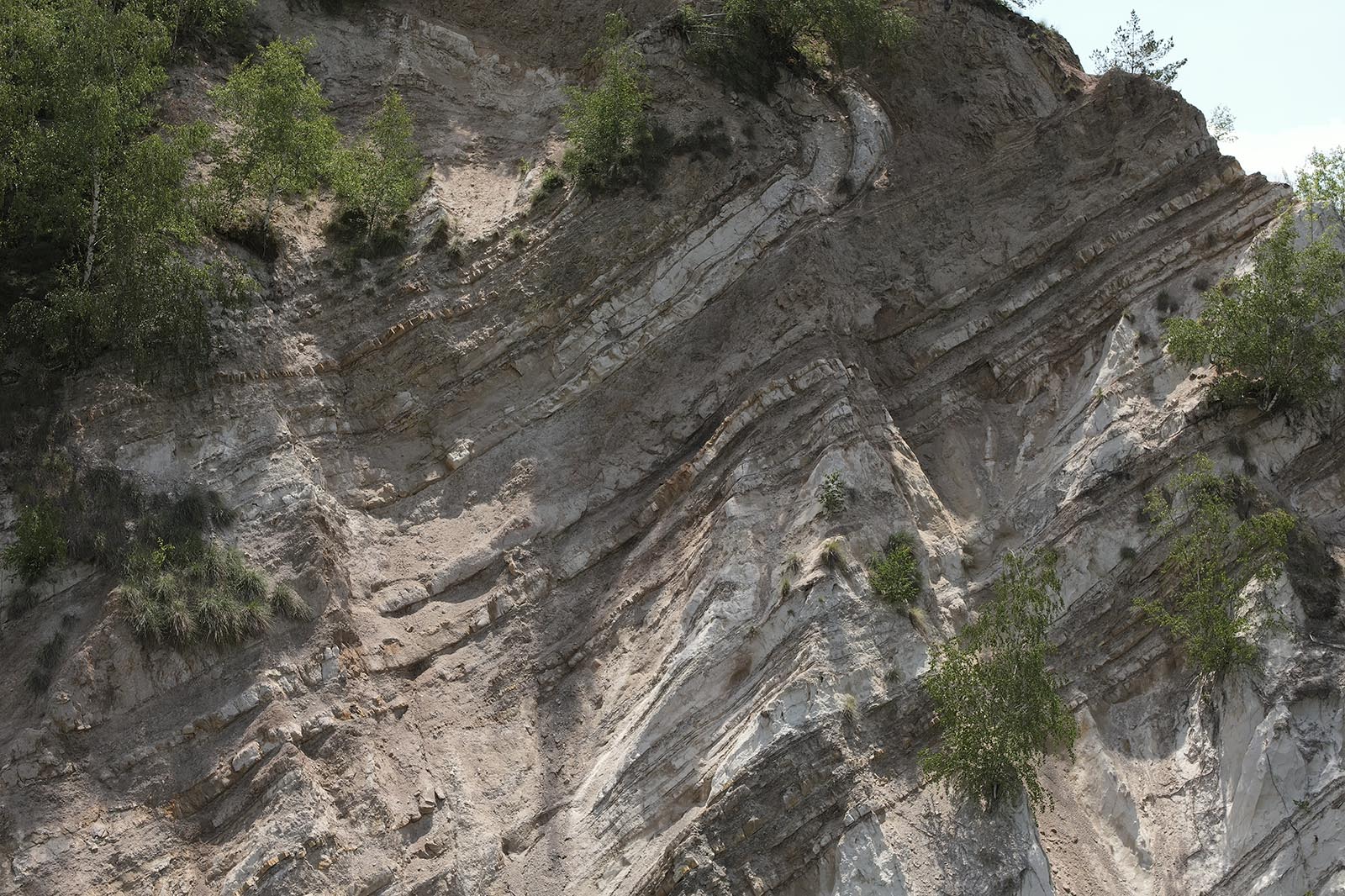
Kliwa sandstone reservoirs and organic-rich source shales in the sub-salt succession.
Day 2

Reservoirs, seals and seal failure in the supra-salt units

Berca · Slănicul de Buzău · Mânzălești · Berca Mud Volcanoes

Following the Foredeep structural framework from Quaternary deposits down into the Miocene and the Subcarpathian nappe, we examine the reservoir–seal packages of the supra-salt succession. The Mânzălești salt outcrop — the largest rock-salt exposure in Europe, roughly 2.7 by 1.3 km at surface — sits at the Tarcău–Subcarpathian nappe boundary and shows the dual role of the Lower Miocene salt as both top seal and décollement. West of the diapir, the “eternal flames” (an optional, weather-permitting stop) show gas escaping through a breached seal where the evaporites have been eroded; the day closes at the Berca mud volcanoes, surface expressions of deep, overpressured hydrocarbon-bearing layers.
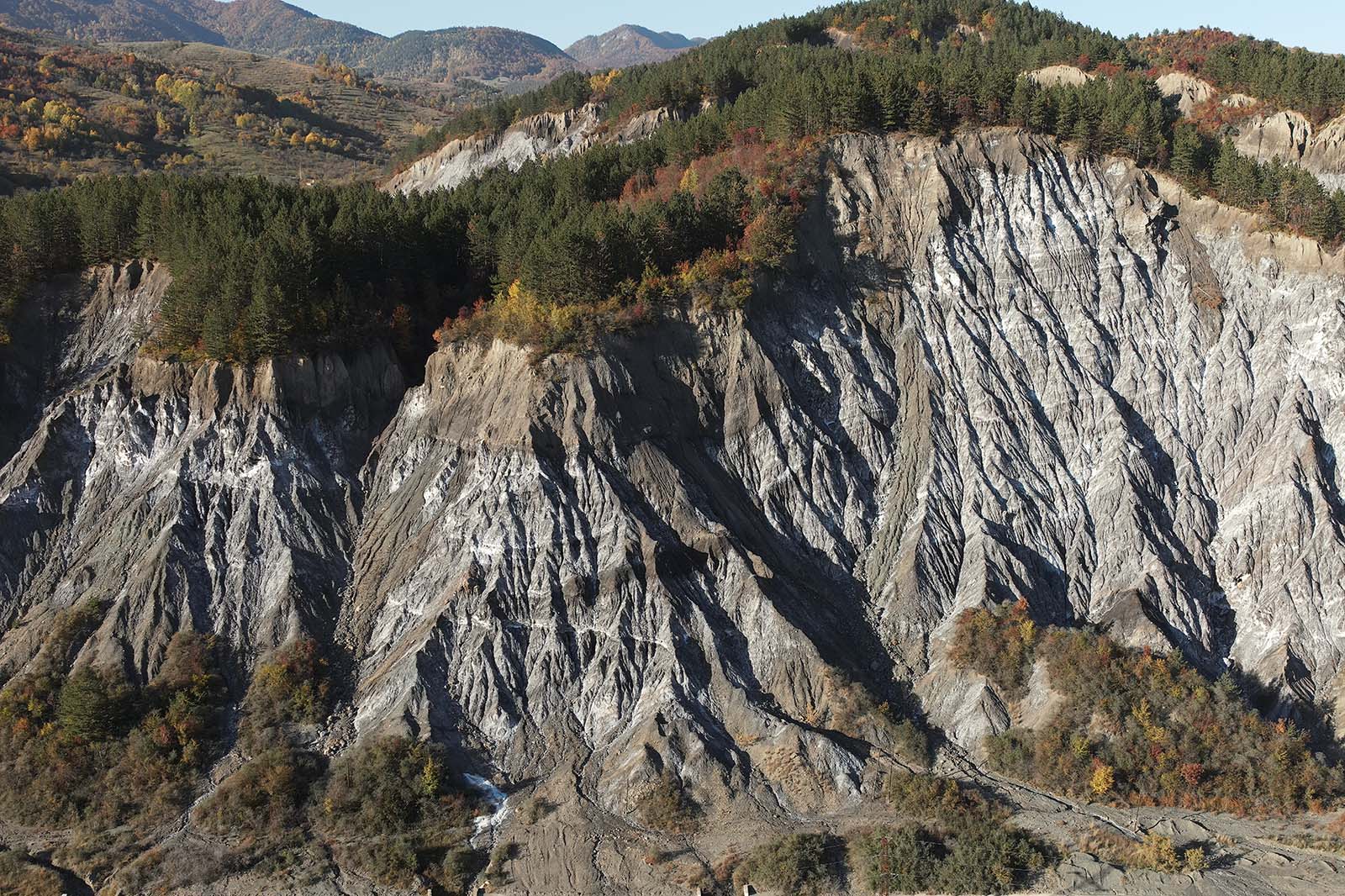
The Mânzălești salt diapir — the largest rock-salt exposure in Europe.

Optional extensions

The three-day programme can be extended with additional days and stops, for example:

Optional

Valea Putnei (Putna Valley), Vrancea

Greșu · Lepșa · Tulnici · Coza

Additional days in the Vrancea Carpathians along the Putna Valley — Greșu, Lepșa, Tulnici and Coza — with well-exposed Oligocene–Miocene flysch of the Tarcău and Vrancea nappes: reservoir and source-rock successions and thrust structures in a classic, scenic transect through the belt.

Prerequisites

Technical

A background in geology or a related geoscience is recommended; the course suits practising professionals and postgraduate students alike, and participants working on petroleum systems will find the outcrop-to-subsurface links directly applicable to their own assets.

Physical

Participants should be comfortable walking over uneven terrain, in quarries and along river sections for several hours a day. A reasonable level of fitness is required.

What's included

Included
  • High-visibility vest and safety helmet
  • Expert field guidance from the trip leaders
  • Field guide and supporting materials
Not included
  • Transport
  • Accommodation
  • Meals
  • Insurance

Selected publications

  1. Primary referenceStructure and petroleum systems of the Eastern Carpathians, Romania
    Krézsek C., Schléder Z., Olaru-Florea R., Tămaș A., Oteleanu A., Stoicescu A., Ungureanu C., Dudus R., Tari G. (2023). Marine and Petroleum Geology, 151, 106179.
  2. Primary referenceSalt tectonics style in the Bend Zone sector of the Carpathian fold and thrust belt, Romania
    Schléder Z., Tămaș D.M., Arnberger K., Krézsek C., Tulucan A. (2019). International Journal of Earth Sciences, 108(5), 1595–1614.
  3. Understanding salt in orogenic settings: the evolution of ideas in the Romanian Carpathians
    Tămaș D.M., Schléder Z., Krézsek C., Man S., Filipescu S. (2018). AAPG Bulletin, 102(6), 941–958.
  4. Middle Miocene evolution and structural style of the Diapir Fold Zone, Eastern Carpathian Bend, Romania: insights from scaled analogue modelling
    Tămaș D.M., Schléder Z., Tămaș A., Krézsek C., Copoț B., Filipescu S. (2020). Geological Society of London, Special Publications, 490, 267–284.
  5. The Nature and Significance of Sand Intrusions in a Hydrocarbon-rich Fold and Thrust Belt: Eastern Carpathians Bend Zone, Romania
    Tămaș A., Tămaș D.M., Krézsek C., Schléder Z., Palladino G., Bercea R. (2020). Journal of the Geological Society, 177(2), 343–356.
  6. Hydrocarbon source rock potential and paleoenvironment of lower Miocene diatomites in the Eastern Carpathians Bend Zone (Sibiciu de Sus, Romania)
    Tulan E., Sachsenhofer R.F., Tari G., Witkowski J., Tămaș D.M., Horvat A., Tămaș A. (2020). Geologica Carpathica, 71(5), 424–443.
  7. Insights into the palaeoenvironments, structure and stratigraphy of the lower Miocene of the Eastern Carpathians Bend Zone, Romania
    Bercea R.I., Balc R., Tămaș A., Filipescu S., Tămaș D.M., Guillong M., Szekely S.F., Lukacs R. (2023). Geological Quarterly, 67(2), 25–50.